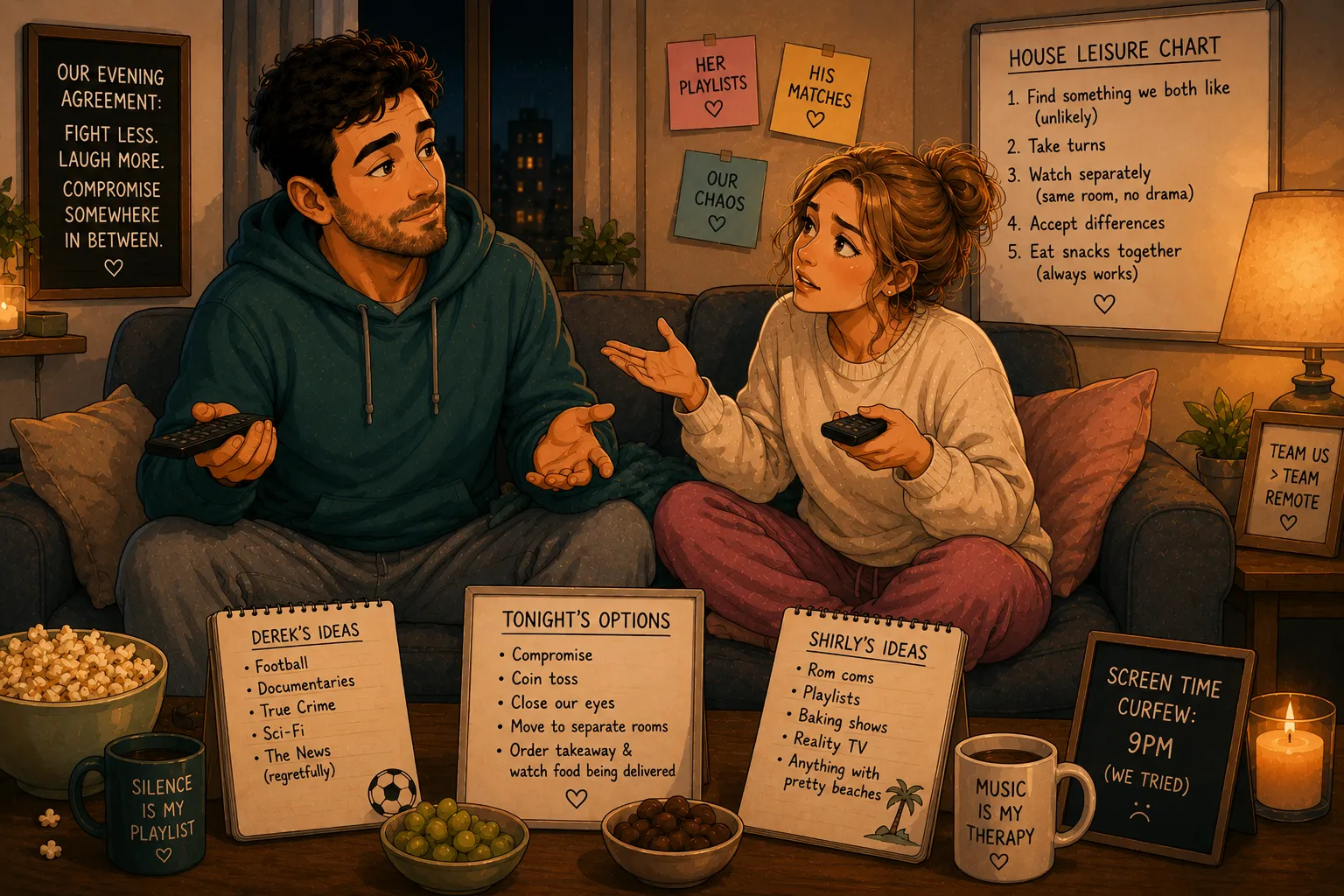
The remote control war was fought nightly. Not with words, with actions. Shirly would pick up the remote and open Netflix. Derek would pick up the remote and open iPlayer. They'd look at each other. She'd say, 'What do you want to watch?' He'd say, 'I don't mind.' She'd say, 'You always say that.' He'd say, 'Because I don't mind.' She'd say, 'You do mind. You just don't want to say so.' And he'd sigh, because she was right, and because admitting she was right meant admitting he'd been pretending to be easygoing when he actually had opinions, and opinions meant conflict, and conflict meant the evening was ruined.
The sport preference was Derek's vice. He liked football. Shirly didn't. She didn't dislike it, she just didn't understand why grown men chasing a ball warranted the level of emotional investment Derek gave it. He'd sit on the sofa, leaning forward, fists clenched, whispering instructions to professional athletes who couldn't hear him. She'd sit beside him, reading her book, occasionally glancing up to ask what was happening, which annoyed him more than any opponent's goal.
The music battle was Shirly's territory. She had playlists for everything. Morning playlists, cooking playlists, 'I'm cleaning the bathroom and I need to feel like a protagonist' playlists. Derek liked silence. Not always, but often. He found silence productive. She found silence suspicious. 'Why don't you want music?' she'd ask. 'I do,' he'd say. 'Just not always.' She'd hear: 'Your taste in music annoys me.' He'd mean: 'Sometimes I like to hear my own thoughts.' Neither of them was wrong. Both of them were tired.
The screen time limit was the newest front. Shirly had read an article about digital wellness and decided they both needed to reduce their phone usage after 9pm. Derek agreed, in principle. In practice, he opened his phone at 9:01pm to check the football scores, then got sucked into a thread about a questionable referee decision, and Shirly watched him do it with the quiet disappointment of someone who'd been betrayed by a person who'd agreed to be better.
What they were all really fighting about was this: how do two people share leisure time when their idea of leisure is fundamentally different? The answer, they eventually learned, was not to take turns. It was to find things they both enjoyed, or, more realistically, to find things they could tolerate while sitting next to each other, which is basically the same thing.